

Checkweighers are a vital quality control technology used across many industries to verify products meet specified weight requirements. By performing in-line weighing of every item on the production line, manufacturers can guarantee accurate weights and product consistency while easily meeting Australian regulatory standards.
Even small weighing errors can have significant consequences, including customer dissatisfaction from underweight packages, higher operational costs from giving away excess product, and penalties for failing to meet strict regulations. To counter these issues, effective checkweighing relies on capturing accurate weight data. This information is far more than a simple measurement—it’s a critical input that drives decision-making across the entire supply chain.
By leveraging this data, manufacturers ensure customers and supermarkets are getting what they paid for, gain insights to optimise processes and reduce waste, accurately manage costs (especially logistic/freight charges), and achieve the traceability required for stringent compliance.
Ultimately, precision weighing is no longer a routine task; it’s a strategic asset that helps businesses streamline workflows, minimise errors, and remain highly competitive in today’s fast-moving markets.
What Is Weight Data Capture in Checkweighing?
Weight data capture is the process of recording and transferring the weight information collected during weighing a product so it can be stored, analysed, and applied across manufacturing and quality control systems. It transforms a simple measurement into actionable data that strengthens compliance, efficiency, and decision-making.
The Weighing Instrument
The process begins with a scale or checkweigher, which takes precise measurements of products as they move through the production line. Accuracy at this stage is critical, as it forms the foundation for all subsequent analysis and reporting.
Data Transmission
Once recorded, the weight data must be transferred to another system for use. This can be done through a direct connection, such as a USB adapter, serial ports (RS-232), or via a network connection, where Ethernet, wireless, or Bluetooth adapters are used for faster transfer. In some environments, portable data logger devices are employed that temporarily store the weight information and later upload it to a computer or central system.
Software Integration
Specialised software then captures and organises the transmitted data and often integrates directly with commonly used tools such as Microsoft Excel, ensuring the information is readily available for day-to-day analysis and long-term planning.
Data Analysis & Storage
Finally, the captured data is stored and analysed. This step enables the generation of reports, trend analysis, and updates to live production systems. Over time, the accumulated data provides valuable insights into process performance, helps reduce waste, and ensures that every product meets quality and compliance requirements.

The Benefits of Weight Data Capture in Checkweighers
Implementing weight data capture solutions in checkweighers provides businesses with a range of operational, compliance, and efficiency advantages. By transforming raw weight readings into organised, accessible information, these systems help ensure accuracy, reliability, and smarter decision-making across the production cycle.
So what exactly does weight data capture do for a business?
- Reduces Errors: Automating data entry removes the risk of mistakes that often occur with manual record-keeping. This ensures that information remains accurate and consistent, reducing costly rework or disputes.
- Maintains Regulatory Compliance: Weight data capture improves traceability, providing a clear audit trail that helps businesses meet strict industry regulations. This not only supports compliance but also builds customer trust in product integrity.
- Increases Efficiency: By eliminating the need to manually record and transfer data, weight capture solutions save significant time and frees staff to focus on higher-value tasks. This efficiency gain also accelerates production throughput.
- Enables Real-Time Monitoring: With continuous data capture, businesses can monitor processes and productivity in real time. This capability enhances workflow efficiency across shipping, production, and inventory management by allowing immediate responses to any deviations.
- Improves Data Integrity: Recording data concurrently with each product going through the production line strengthens accuracy and reduces the risk of issues such as backtracking, misreporting, or even data fabrication. Reliable records form the backbone of effective quality control.
- Facilitates Reporting: Captured weight data can be compiled into timely reports that provide management with meaningful insights. These reports support better decision-making, whether for day-to-day operations or long-term strategic planning.
Key Components
A checkweighing setup relies on several integrated components, each playing a crucial role in ensuring accurate measurement, reliable data handling, and seamless connectivity across the production process.
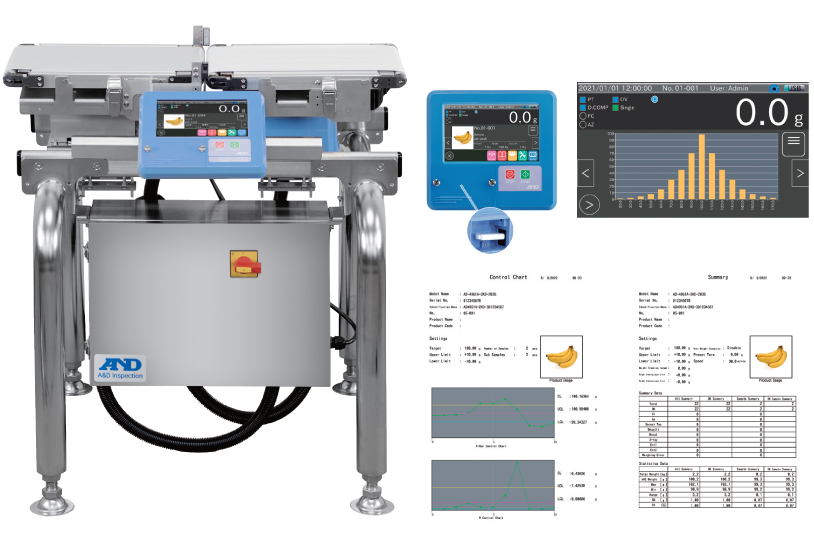
- Weighing Scales & Instruments: At the core of any checkweighing system are the precision scales or checkweighers themselves. These instruments are responsible for quickly capturing accurate weight measurements of products as they pass along the production line, ensuring each item falls within specified tolerances.
- Software: Software solutions not only make it easier to view and transfer data into systems like spreadsheets, but also enable analysis, reporting, and integration with broader quality control processes.
- Connectivity Adapters: To link weighing instruments with computers or networks, a variety of connectivity options are available. Adapters such as USB, Ethernet, Bluetooth, or wireless modules facilitate smooth data transfer, ensuring compatibility with modern digital infrastructure and supporting real-time monitoring where required.
What Features Should I Look For in a Data Capture Enabled Checkweigher?
- Compatibility With Existing Systems: When choosing a data-enabled checkweigher, the most important factor is its compatibility with your current Management Systems. Seamless integration allows weight data to flow directly into your broader business operations, eliminating manual data entry and the need for costly bridging software.
- Accuracy, Scalability, Security: Businesses should evaluate the accuracy, scalability, and security of data handling. Precision in measurement ensures compliance and product consistency, while scalability allows the system to grow with production demands. Equally important is data security, as captured weight information often feeds into critical operational and financial systems that require reliable protection.
- Connectivity Options: Another factor is the range of connectivity options. Modern checkweighers should support flexible connections such as USB, Bluetooth, Wi-Fi, or even cloud-based integration. These features allow real-time data transfer, remote monitoring, and smooth communication between the weighing equipment and other digital systems.
Conclusion
Weight data capture is a vital tool for modern businesses, helping to reduce costs, enhance accuracy, and support operational growth. By automating measurement and data management, it ensures reliable records, optimises processes, and provides actionable insights that drive efficiency and informed decision-making. You can read more about weight data capture here, or browse A&D’s wide range of products here. Got a question? You can get in touch with us directly here.