

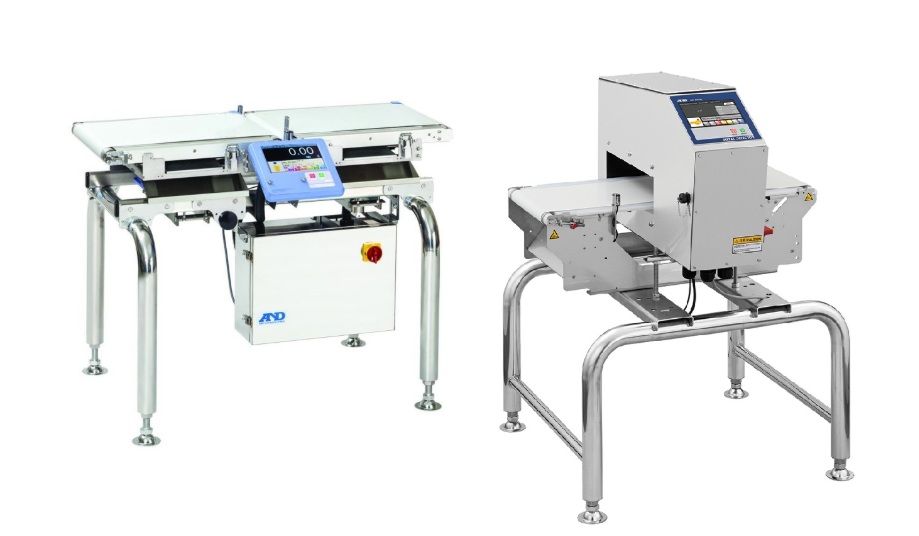
Checkweighers and food metal detectors are essential components of modern manufacturing and packaging industries, ensuring accuracy, speed and safety across a wide range of sectors.
Integrating a checkweigher and metal detector into a production line provides a robust dual-layer defence that safeguards both your brand reputation and operational efficiency. This combination ensures comprehensive quality control by simultaneously mitigating the risk of physical contaminants and preventing costly underfill or overfill incidents.
Beyond safety, the real-time feedback from a checkweigher allows for precise adjustment of filling equipment, which minimises product giveaway and optimises raw material usage, directly enhancing your bottom line through increased yield and reduced waste.
What Are Checkweighers and Metal Detectors?
Checkweighers are precision instruments used in manufacturing and packaging environments to measure the weight of products as they move along production lines. Their primary role is to ensure that items meet specified weight criteria, helping to maintain consistent quality and reduce waste. By identifying underweight or overweight products, checkweighers play a vital role in quality assurance, ensuring compliance with regulatory standards and customer expectations.
Metal detectors are devices designed to detect unwanted metal contaminants in products during the manufacturing process. They play an essential role in safeguarding the quality and safety of food and other goods by identifying ferrous and non-ferrous metals that could pose a risk to consumers. The integration of metal detectors into production lines helps prevent costly recalls, enhance product safety, and ensure compliance with industry regulations.
Together, checkweighers and metal detectors are a critical part of quality assurance in both the food and manufacturing sectors, enhancing product integrity and safety while minimising risks of contamination and inaccurate measurements.
| Feature | Checkweigher | Metal Detector |
| Primary Function | Verifies Weight Accuracy | Detects Contaminants |
| Detects | Over/Underfilled items | Metal (Ferrous & Non-Ferrous) |
| Action | Rejects based on weight | Rejects based on safety |
| Benefit | Protects profit & compliance | Protects consumers & brand |
Technical Issues to Consider Before You Integrate
There are several technical considerations when integrating combination checkweighers and metal detectors.
- Challenges in System Integration: Achieving initial synchronization between the detection and weighing processes may require some trial-and-error. Striking the right balance between sensitivity levels and product-related challenges for both functions can be complex. Once these systems are optimally set up, however, they enhance product handling by consolidating multiple stages into a single inspection point.
- Product Handling Considerations: Operators must understand the ideal spacing and orientation of products for precise inspections, which can be tricky with lightweight or unstable items. Selecting models with inline inspection belt designs that prioritize smooth product flow and minimize disruption can facilitate more accurate readings. It is also crucial to consider rejection mechanisms and choose models suited to the specific type of product; for example, air blasts may be less effective for heavier items compared to pusher mechanisms.
- Technological Solutions: Recent technological advancements allow for customisation of combination units to better meet operators’ needs. When selecting a metal detector, it’s advisable to choose one with multi-frequency detection capabilities. For checkweighers, look for high-accuracy weight technologies and systems rated IP65/69K for washdown environments. Additionally, many operators favour intuitive touchscreen interfaces for ease of use.
Why A&D’s Metal Detector and Checkweigher Systems are Often Sought After
A&D Checkweighers: In a landscape of growing complexity driven by regulations and the need for greater efficiency, businesses are constantly turning to our range of precise and accurate checkweighers. No matter what sector you specialise in, A&D can tailor a solution to meet your specific requirements, taking into account factors like throughput, sanitation, and network connectivity. Our in-motion checkweighers not only safeguard your brand, but they also lower costs, featuring a user-friendly interface that simplifies staff training.
A&D Metal Detectors: Our industrial-grade inline metal detection system can identify ferrous, non-ferrous, and stainless steel contaminants as small as 0.2 millimeters, while effectively reducing false rejects. Furthermore, our modular design and stainless steel construction, along with a washdown rating, enable users to quickly disassemble the machine for easy maintenance and thorough cleaning. Whether your application is in food and beverage, pharmaceuticals, plastics, packaging, or a variety of other industries, A&D Inspection is dedicated to supporting you in delivering the highest quality products to your customers.
A&D Inspection has built a reputation for reliability that goes far beyond the initial hardware. Our customers frequently highlight the speed of supply, noting A&D’s ability to deliver high-precision checkweighers and metal detectors on tight timelines is a critical advantage in fast-moving production environments.
Beyond the delivery, it is the ongoing technical support and proactive service that truly resonates; knowing that expert help is just a phone call away provides a sense of operational security that is hard to match. This combination of responsive logistics and dedicated after-sales care creates a high level of trust, often turning a single installation into a long-term partnership characterised by repeat purchases as facilities expand and modernise.
The Benefits of Integrating Checkweighers & Metal Detectors into Your Lines
- Enhanced Production Efficiency: Integrating checkweighers and metal detectors allows you to streamline your production process and boost overall efficiency. Checkweighers ensure that products adhere to weight specifications, while metal detectors identify any potential metal contaminants.
- Reduced Product Recalls: By integrating checkweighers and metal detectors, you can significantly minimise the risk of product recalls. Regularly verifying both weight and the absence of contaminants ensures that any non-compliant items are identified and removed before they reach consumers. This proactive approach greatly reduces the likelihood of costly recalls, thereby protecting your brand’s reputation and ensuring customer safety.
- Better Data & Reporting: The integration of checkweighers and metal detectors provides robust data tracking capabilities, enabling easier analysis and reporting. Comprehensive data collection allows for insights into production trends, compliance status, and efficiency metrics. This information can be invaluable for making informed decisions, identifying areas for improvement, and maintaining rigorous quality control.
- Consistent Product Quality: Beyond enhancing food safety, the integration of checkweighers and metal detectors significantly improves overall product quality. By guaranteeing that each item is both accurately weighted and free from foreign contaminants, you provide your customers with a consistent and reliable product. This reliability fosters brand loyalty and boosts customer satisfaction, leading to repeat business and favourable reviews.
- Regulatory Compliance: The food industry is subject to rigorous regulations that ensure the safety and quality of products. By integrating checkweighers and metal detectors, you can maintain compliance with these standards and avoid costly fines or recalls. These systems offer detailed reporting and data tracking features, making it straightforward to demonstrate that your products adhere to required regulations. This capability not only builds trust with regulators but also enhances your reputation with consumers.
Industry-Specific Applications
Food & Beverage Industries
The food & beverage industries are arguably the sectors that rely on checkweighing & metal detection the most, given their stringent food safety regulations like HACCP and FSANZ
Metal Detectors are vital for detecting “stray metals” (including stainless steel, ferrous, and non-ferrous) that may enter production lines from damaged machinery, sieves or raw materials etc.
Checkweighers are utilised to avoid “under-filling,” ensuring legal compliance, and “over-filling,” which helps safeguard profit margins.
Pharmaceutical & Nutraceutical Industries
Precision is paramount in these fields, where even a milligram difference can determine the safety of a dose.
Checkweighers are relied upon to check for missing elements, such as a blister pack or instruction leaflet, inside sealed cartons.
Metal Detectors are typically located at the tablet press outlet or before bottling to detect microscopic metal fragments originating from pill-pressing dies.
Cosmetics & Personal Care Industries
Within these industries, the emphasis is on brand protection and maintaining aesthetic consistency.
Checkweighers ensure that high-value creams, perfumes, and aerosols are filled to the precise volume. They can also identify missing components, like pump heads or caps, based on weight discrepancies.
Metal Detectors are essential for products with pumps containing metal springs or for items packaged in tubes where contaminants may be introduced during the sealing process.
Chemical & Industrial Industries
In this arena, the scale often shifts from grams to kilograms or even tons.
Checkweighers are used for large bags (25 kg+) of resins, fertilizers, or cement to ensure batch consistency and maintain pallet stability.
Metal Detectors are deployed on conveyors to prevent downstream machinery, such as grinders or shredders, from being damaged by large metal debris.
Logistics & E-commerce Industries
With the rise of automated warehouses, these tools have become essential for ensuring shipping accuracy.
Checkweighers confirm that the contents of a shipping box match the digital manifest. If a box is 200g too light, the system flags it, indicating that an item may have been overlooked by the picker.
Metal Detectors are utilised in some high-security logistics settings to scan for unauthorized items or protect sorting equipment.
Conclusion
Ultimately, checkweighers and food metal detectors play a critical role in ensuring efficiency, quality, safety, and financial savings across various industries. You can head over to the A&D homepage to check out our full range of products and services, or contact us directly here.